- For a typical tourist desert safari with dune bashing, the safest default is a licensed guided tour in the operator's prepared 4x4 — not an ordinary self-drive rental.
- A rental SUV may be used off road only when the contract and insurer explicitly permit the exact route and activity in writing.
- A Land Cruiser, Patrol or Wrangler badge does not by itself make a booking desert-approved; trim, tyres, recovery equipment, driver experience and insurance all matter.
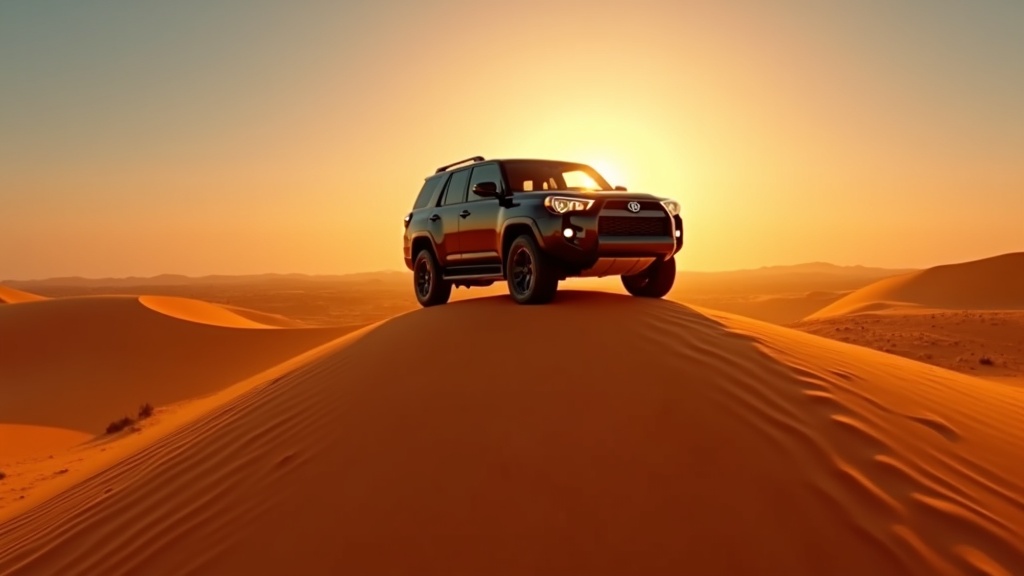
The best car for a Dubai desert safari is usually the 4x4 supplied with a professional safari driver. If your plan is only to reach a desert hotel, viewpoint or camp on paved roads, a normal rental may be enough. If you intend to drive on sand or dunes yourself, stop at the contract first: you need written off-road permission, valid insurance for that use and a vehicle prepared for the route.
Reviewed 16 August 2026. This guide separates official visitor information from rental-provider rules. It does not grant off-road permission for any vehicle listed on this website.
Choose the trip first, then the vehicle
| Your plan | Practical vehicle choice | What to confirm |
|---|---|---|
| Guided dune-bashing safari | The tour operator's 4x4 and professional driver | Pickup, passenger limits, health restrictions and operator terms |
| Drive to a desert resort or paved viewpoint | A normal road rental suitable for your passengers and luggage | That the full route is paved and allowed by the rental agreement |
| Use a maintained gravel or access track | Only a vehicle and route approved by the provider | Written route permission and whether cover continues off tarmac |
| Independent sand or dune driving | A properly equipped low-range 4x4, experienced driver and companion vehicle | Written off-road cover, recovery liability, route limits and emergency plan |
Visit Dubai's listed safari experiences use 4x4 vehicles with guides and include pickup and drop-off. Its dune-buggy experiences also place guests on guided routes and provide safety equipment. That is a different product from collecting a normal road rental and deciding to enter the dunes.
Do not treat “SUV”, “AWD”, “4x4” or “comprehensive insurance” as permission to drive off road. Ask the provider to identify the permitted activity and area in writing. If the reply is vague, keep the vehicle on permitted roads and book a guided safari separately.
Which 4x4 types are commonly considered for sand?
Full-size and purpose-built 4x4s are commonly used because some versions offer low-range gearing, useful ground clearance and durable drivetrains. The exact trim matters: a model family may include both road-focused and off-road-focused versions.
| Model family | Why it is considered | Verify on the exact rental |
|---|---|---|
| Toyota Land Cruiser | Full-size 4x4 platform commonly used by regional tour operators | Low-range system, tyres, recovery points and written off-road permission |
| Nissan Patrol | Large 4x4 with strong passenger capacity and regional familiarity | Trim, tyre condition, recovery equipment and insurance exclusions |
| Jeep Wrangler Rubicon | Purpose-built off-road hardware on the Rubicon trim | Exact trim, roof or door rules, passenger comfort and contract limits |
| Toyota Fortuner 4x4 | Smaller body-on-frame alternative in versions equipped with four-wheel drive | That it is the 4x4 version, permitted terrain and recovery cover |
This is a capability shortlist, not a promise that any corresponding listing is approved for dune bashing. A standard road-rental contract can prohibit off-road use even when the vehicle itself is capable.
What makes a vehicle desert-ready?
- Appropriate four-wheel-drive hardware. Confirm the exact system and whether low range is present; do not infer it from the model badge.
- Suitable tyres in good condition. Tyre type, age, sidewall condition and pressure limits affect sand performance and safety.
- Recovery points and equipment. A shovel or recovery boards are not a substitute for training, but entering remote sand without an approved recovery plan increases risk.
- Cooling and mechanical condition. Heat and low-speed operation increase load. Use only a vehicle the provider has approved for the intended activity.
- Written insurance position. Ask whether off-road damage, underbody damage, tyres, wheels, recovery and towing are covered or excluded.
- A trained driver and a second vehicle. Independent dune driving is not a sensible first-time tourist activity. A guide changes the risk far more than upgrading the badge on the bonnet.
Questions to send the rental provider
- Is off-road driving permitted for this exact registration number?
- Which named areas, tracks or activities are permitted and which are excluded?
- Does the insurance remain valid on sand, and what is the excess?
- Who pays for recovery, towing, tyres, wheels and underbody damage?
- Does the vehicle include approved recovery points and equipment?
- Is a guide, orientation or companion vehicle required?
- Can the provider send the relevant contract clause before payment?
Keep the reply with your booking confirmation. A phone assurance is difficult to rely on after damage or a recovery call.
Guided safari or self-drive rental?
Choose a guided safari if dune bashing is the experience you want. Visit Dubai describes products that combine hotel transfer, a guide and a 4x4 dune drive; some activities also have passenger or health restrictions. This removes the need to select, prepare and recover a vehicle yourself.
Choose a road rental when the car is for the rest of your Dubai trip and the desert activity is handled by a tour operator. That arrangement is often clearer: the rental stays on permitted roads, while the specialist operator is responsible for the safari vehicle and route.
Consider independent off-road driving only if you already have relevant experience, the provider gives specific written permission and cover, and you have a route, companion vehicle and recovery plan. This page cannot assess those conditions remotely.
Frequently asked questions
Can I take a rental SUV dune bashing in Dubai?
Only if the contract and insurer explicitly permit dune driving for that exact vehicle and route. An SUV listing or an AWD badge is not permission. If written approval is unavailable, use a guided safari vehicle.
Do I need to rent a 4x4 for a guided desert safari?
Usually no. Guided safari products commonly include the operator's 4x4 plus hotel pickup and drop-off. Confirm the inclusions and passenger restrictions with the operator.
Is a Toyota Land Cruiser automatically desert-approved?
No. The model may be capable, but approval depends on the exact vehicle, tyres, contract, insurance and route. Ask for all of those points in writing.
What is the best rental for a desert hotel on paved roads?
Choose for passenger count, luggage, comfort and total price. If the full route is paved and permitted, a specialized off-road 4x4 may not be necessary. Confirm the route with the hotel and rental provider.
- Visit Dubai: Desert Safari in Dubai
- Visit Dubai Experiences: Desert Experiences
- Visit Dubai Pass: guided morning safari details
Rental permission, insurance and recovery liability are contract-specific. Obtain them directly from the provider and insurer for the exact booking.